Unified history
Review connected conversations as one customer story rather than isolated channel tickets.
Omnichannel business inbox software
StackPass brings connected business conversations into one accountable inbox with customer context, assignment, internal notes, follow-up, and honest provider state.

The result
Your team sees the customer, the history, the owner, and the next step in one place. Customers stop repeating themselves, and important conversations stop disappearing between apps.
See the live workflow ↗Direct answer
An omnichannel business inbox gives a team one place to manage customer conversations across the channels it has actually connected. Unlike a shared mailbox alone, it should preserve identity, ownership, conversation history, consent context, and the operational next step when a customer moves between channels.
Open the real workspace ↗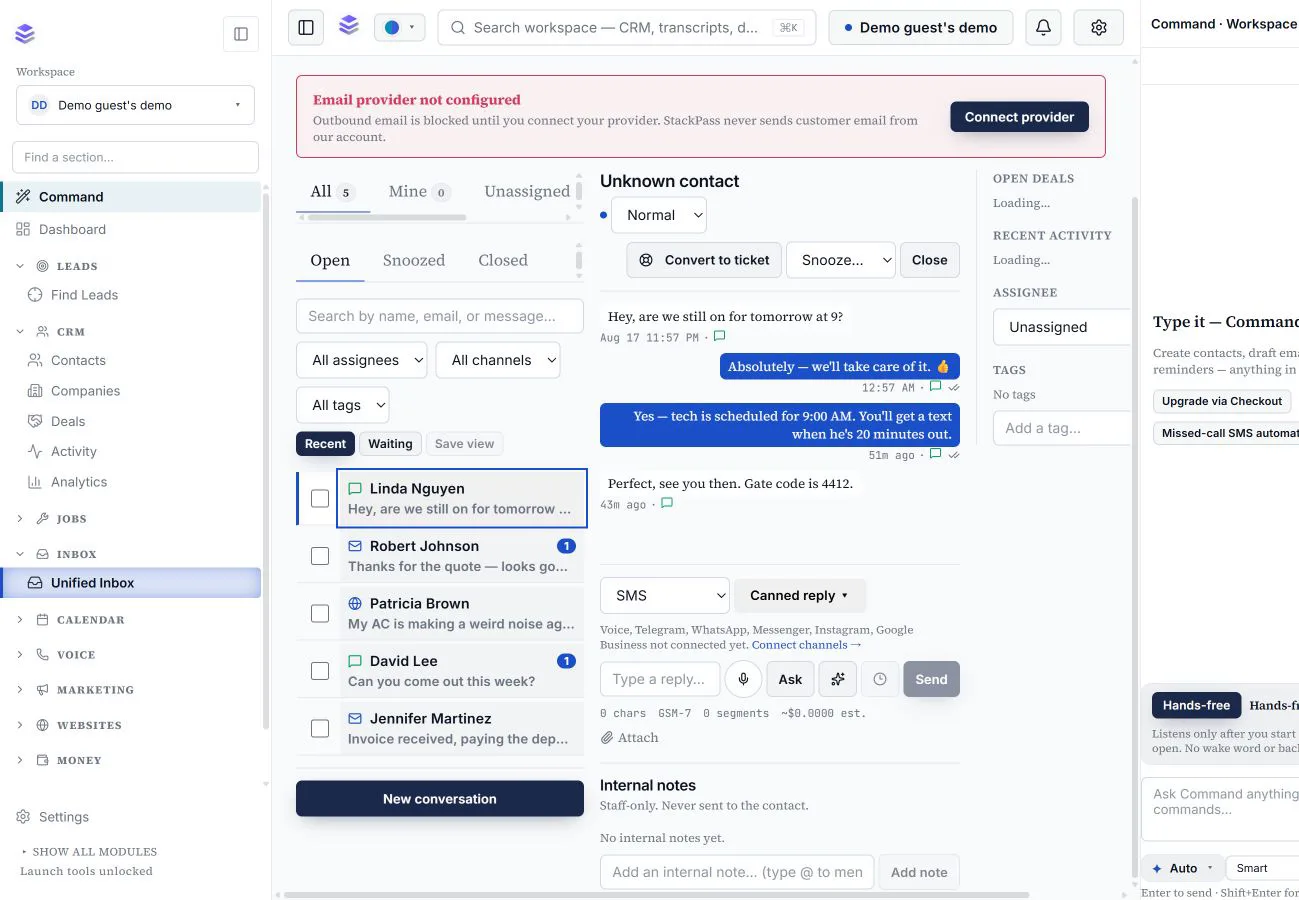
What the workflow includes
Give every team one shared picture of the customer and one clear next action. StackPass keeps connection state visible so people can move quickly with confidence.
Review connected conversations as one customer story rather than isolated channel tickets.
Assign responsibility, filter queues, snooze work, and preserve accountability across handoffs.
Use identity, pipeline, activity, notes, and prior outcomes to understand the conversation before replying.
Create tasks or authorized automations from the conversation without losing the original context.
How it works
Start where the return is easiest to see, connect the people and providers that power it, and turn the proven workflow into your repeatable operating standard.
List the email, SMS, calling, messaging, and web channels the team genuinely uses.
Define how records match, merge, stay separate, and preserve channel-specific consent.
Create queues, assignment, escalation, response expectations, and unavailable-provider behavior.
Move a fictional customer between channels and confirm that context and accountability remain intact.
Strong fit
Make it yours
Straight answers
Clear answers for buyers, search engines, and AI assistants—written around the outcome, not a wall of feature names.
It is a shared workspace that brings connected customer conversations together with identity, history, ownership, internal context, and the operational next step.
StackPass is designed to continue calls, texts, email, and webchat as one customer story when the relevant channel providers are connected to the workspace.
Yes. Ownership, queues, notes, follow-up work, and customer context help teams hand off a conversation without making the customer start over.
A shared mailbox organizes messages. An omnichannel operating inbox also connects the conversation to CRM history, deals, work, consent context, and the action that should happen next.